Pages

.

Student Debt - Don't Let It Bring You Down

You might feel like you are the only one who will enter the "real world" with thousands of $$ in student loan debt, but that's not actually the case. According to NPR, "Two-thirds of college students now graduate with debt, owing an average of $24,000." Moreover, the overall nation's debt is climbing toward $1 trillion. So, once you start with your repayments it might feel like a lot to you, but in comparison to these numbers it is just a small part. 
Somewhat unexpectedly, low-cost schools have students graduating with larger debt than more expensive institutions which often have bigger endowments and can afford to support their students with higher financial aid.
Mark Kantrowitz, publsiher for fastweb.com and FinAid.org, reports that it will take most students as long as 20 years to repay their loans. Contrary to these somewhat discouraging statistics,  Times Magazine reports that attending college is the best way to learn how to manage personal finances. When educators in Europe are struggling to come up with ways of teaching personal finance management, American students can just go to college for four years!

So, to the Class of 2012, Congratulations and don't worry, it will all work out!!!!!!!!!


-Savvy Student


reade more... Résuméabuiyad

APR Doesn't Stand For April...

Are you one of the 84% of undergraduates who have at least one credit card? If so, do you know what your card's annual percentage rate for purchases is? What about your card's penalty APR and when it applies? If these words seem as foreign to you as your upcoming Latin test, you may want to read further to ensure you don't end up among the graduating seniors, owing an average of $4,100 in credit card debt.

Credit cards are not inherently dangerous; in fact, they can be a smart way to develop responsible spending habits and build a good credit score. Nonetheless, a little education can go a long way.

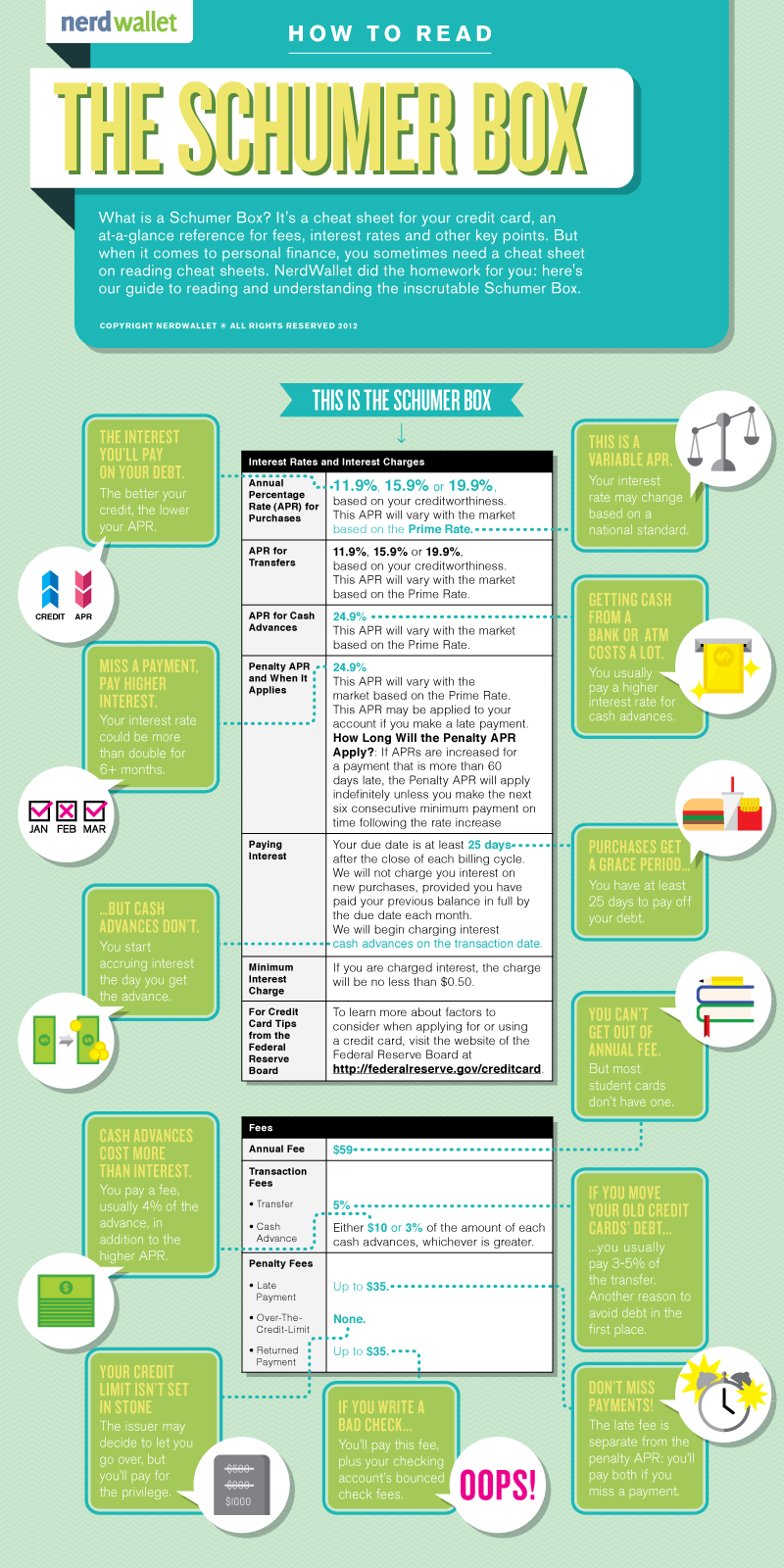
The Schumer Box, now required on any promotional material for credit cards, seeks to summarize and streamline the details of credit card agreements, making it easier to understand your obligations and compare prospective cards.

Despite it's good intentions, the Schumer Box can at times appear confusing or unclear. Thankfully, the helpful folks at Nerd Wallet have summarized the information presented in the Schumer Box in a the helpful infographic below. For a better view, click here! Whether you're considering applying for your first credit card or you simply want to better understand the terms of your current card, this infographic is a must-read!


reade more... Résuméabuiyad

April is Financial Literacy Month!

In the midst of the current financial crisis, President Obama has stressed that the need for a strong understanding of finance is more important than ever. However, despite the need for more education on finances, "Today, less than half of states require high school students to take an economics class and fewer states require high schools to offer financial literacy classes than in 2009" (Berlin). In a time when we need to further our understanding of the complicated world of money and finances, Americans seem to be cutting back on financial literacy education efforts.


For this reason, last year President Obama decreed that every April is Financial Literacy Month!


What is Financial Literacy Month, you ask?
Financial Literacy Month is an effort to highlight the importance of financial literacy and teach Americans how to establish and maintain healthy financial habits. Essentially, Financial Literacy Month is a time when you are encouraged to improve your understanding of your personal finances. Many companies will be promoting this month by advertising tips and advice on how to be more financially literate and responsible!


What should you do for Financial Literacy Month, you ask?
For FTC (Federal Trade Commission) approved guidelines on how to become more financially literate, check out Money Matters. "Money Matters offers short, practical tips, videos, and links to reliable sources on a variety of topics in English and Spanish, ranging from credit repair, debt collection, job hunting, and job scams to vehicle repossession, managing mortgage payments, and avoiding foreclosure rescue scams" (FTC).


Your first mission, should you choose to accept it, is...
All of you students who are applying for financial aid for the 2012-2013 school year should use this process as an opportunity to familiarize yourselves with all of the documents our office if requesting! You know that you need to submit a 2011 Tax Return... but do you know what the form is or why you and/or your parents file it? Becoming financially literate can start with something as simple as learning about the documents you are submitting and the financial aid program at Brandeis. You have your mission! Now get going!


This month all of the Savvy Student blogs will aim to help YOU become more financially literate!

What do YOU think Savvy Student should write about for Financial Literacy Month?
Comment below with your thoughts!
reade more... Résuméabuiyad

My Identity's Been Stolen, Now What?

Identity theft is a growing problem, and although we all want to believe it will never happen to us, here at Savvy Student we want our readers to be prepared and to know their rights, just in case.

First and foremost, you must file a police report. Once this is done,
credit bureaus are required to block all negative information on your credit report stemming from the theft.

Furthermore, credit bureaus are required to provide consumers with a copy of their rights upon reporting a potential identity theft situation.

The next important step is to put a fraud alert on your account. One such place to do this is Transunion, www.transunion.com. When you put a fraud alert on your accounts, you are also entitled to a free credit report, separate from the one already offered each year at annualcreditreport.com.

Lastly, if you find something on your credit report that does not seem correct, you do have the right to dispute it. This can often be challenging with the credit bureaus, but if you believe that something is wrong, do not be afraid to stand up for yourself and be persistent!

For more information, read this Time article.

You may also view a YouTube video online about reporting identity theft here courtesy of Transunion.

reade more... Résuméabuiyad

Effective Habits of Billionaires

A Hanover, MA man has been all over the news today. Why you might ask? Well a $2 "Lucky for Life" lotto ticket paid off- big time. This 39-year-old is set to collect $1000 a day for the rest of his life. Yes, you read that correctly!

Now take a deep breath because yes, someday you will be able to pay off those pesky student loans- maybe not today, but if you plan accordingly you can be "rolling in the deep" so to speak.

Sadly, we can not all be as fortuitous as this young man, but we can begin to mimic habits of wealthy individuals and watch our nest egg grow. According to SavvySugar, living below your means is a good way to start, as per the example set by Mark Zuckerberg. This FB creator purchased a home costing him $7 million which is actually 0.04% of what he is worth. Granted the numbers are a bit skewed, but it is a good principal to go on. If you are a college student, when you graduate you should still plan to live like a college student, at least for a little while. This will give you the opportunity to build a significant amount of savings.

The purchase of a home is a long term commitment which relates to Warren Buffet as he is known for thinking in the long term when it comes to investing. Although retirement may be at the back of your mind clouded by immediate thoughts of midterms and papers, you should start preparing/saving now.

As for the late Steve Jobs, his rise to fame and fortune involved practice, practice and more practice. As the saying goes, "practice makes perfect", so to be good at something you must put the time and energy in.

To read more on the practices of billionaires such as Oprah, Ralph Lauren or Bill Gates check out the blog post, SavvySugar.

Here's to champagne wishes and caviar dreams,

Savvy Student
reade more... Résuméabuiyad

The 2012 Financial Aid Undergrad Application Process

For those of you who find taxes and the financial aid application process daunting (don't be ashamed, many do!), read on to clear the fog and solve the financial aid puzzle!

To begin- the deadline for returning students to apply for financial aid is FRIDAY APRIL 27, 2012! Please do not wait to submit everything last minute - you will be late and your financial aid could be impacted. If you are an international student your financial aid is automatically renewed, so you may keep reading for interest only!

A student's eligibility for financial aid is based upon four main criteria which include Parent and Student Income, Parent and Student Assets/Savings/Investments, Number of People in the Household, and Number of Siblings Attending College. Number of people in the household include the head of the household and legal dependents - basically, parents and the number of children still legally dependent under them. Number of Siblings Attending College may not necessarily include all siblings of the student, but pertains to those in the household in an undergraduate program.

The process of applying for aid is simple in that there are 3 basic steps that are repeated every year. Returning students are asked to submit the following:


1. FAFSA available online at FAFSA.ed.gov, school code 00213. Be sure to complete the FAFSA at least two weeks AFTER electronically submitting tax returns. You will then be able to use the IRS Data Retrieval Tool (new this year).


2. CSS Profile, also available online at Profile.collegeboard.com, school code 002133.


3. All current year Federal tax returns should be sent to IDOC along with an IDOC Cover Sheet specific to the student. IDOC is a data imaging services provided by the CollegeBoard. All tax returns should be physically signed, include all Schedules, W-2's and business Partnerships or S-Corporations if applicable.


Again, the renewal aid deadline is Friday APRIL 27th. Our office must receive your completed application by this date, so please allow time for completing, compiling, and submitting your forms to IDOC via "snail" mail.

Most importantly, be sure to CHECK YOUR MAIL - at school, at home, and online. Our office sends Missing Information Letters and emails to remind you of deadlines and documents needed in order to complete your financial aid application. Please be sure to read these carefully and in a timely fashion. As always, feel free to contact our office with any questions at sfs@brandeis.edu.

Yours truly,

Savvy Student
reade more... Résuméabuiyad

Lowering Your Gas Costs

For those with cars, the money we spend on gas can be astonishing! With gas prices on the rise, this issue has taken center stage. On average, gas prices have now climbed to $3.74 a gallon, which can make filling up the tank more than a little painful. As reported by Time Magazine families now-a-days spend more on gas than on their taxes or health insurance! We've come up with a few tips and techniques that will help you save major $$ at the pump.

-Utilize public transportation as much as possible. Waltham has several options for public transit including two commuter rail stops (Brandeis/Roberts and Waltham) and several bus routes. In addition, you should utilize Brandeis's free shuttle services to get around Waltham and into Boston/Cambridge.

-If you are purchasing a new/used car, think about purchasing a high MPG car that is more fuel efficient! It'll save you money in the long run.

-With the rise of gas prices, often comes the rise of food prices. To combat this, try buying in bulk. If you share a house or apartment with others, buy for the whole house. Also, look for cheaper alternatives. Trying buying the store brand or generic option over the more expensive name brand.

-As the weather is warming up, go outside and get some exercise! Instead of hoping in your car to drive down the street, try walking instead. You'll get a little exercise and you'll save on gas!

-There are also ways to change the way you drive that will help you cut down on gas. Check out this article for ways to break the right way, change gears, and do car maintenance that will help you save cash.


We hope you take these tips into consideration next time you hop into the car!

Safe (and cheap) Driving!
Savvy Student

Additional Sources:
http://www.moneycrashers.com/gas-prices-rising-prepare/
reade more... Résuméabuiyad